Entradas

Key questions about Earth's climates
Imagen
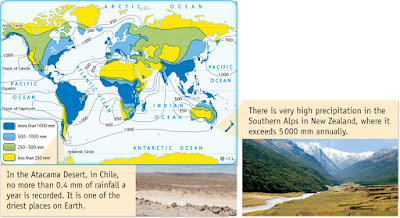
TEMPERATURE: Temperature varies according to latitude, altitude and distance from the sea Climate zones are determined by latitude, and consist of the tropical zone, temperate zones and polar zones PRECIPITATION: Precipitations are determined by: the climate zones (latitude), the wind and atmospheric pressure (low pressures or depression and high pressures or anticyclones), and the relief (orographic precipitation) EARTH'S CLIMATES: The climates can be classified into temperate (oceanic, mediterranean and continental) and extreme (equatorial, tropical, warm desert, polar and high mountain). TEMPERATE CLIMATES: Oceanic, with abundant rainfall throughout the year Mediterranean, with mild temperatures throughout the year and scarce rain in summer Continental, with a great thermal oscillation between winter and summer. EXTREME CLIMATES: The warm equatorial and tropical climates have high temperatures throughout the year. In the equatorial climate, the r...

Vocabulary about the hydrosphere: fresh water and salt water

Imagen
Hydrosphere: hidrosfera Water cycle: ciclo del agua: Surface water: agua superficial Groundwater: agua subterránea Salt water and fresh water: agua salada y agua dulce Scarce: escaso/a Beneath: debajo Salinity:  salinidad Ocean currents: corrientes oceánicas o marinas Tides: mareas Waves: olas River: río Stream: correinte Flow: caudal  Lake: lago Frozen: congelado/a Shallow: superficial Surround: rodear Enough: suficiente Watershed: vertiente https://pmm.nasa.gov/education/water-cycle

Quizs about relief, seas, rivers... (Flash player required)

Imagen
Let's play and learn geography:  To start, something easy: continents and oceans Continents Oceans Mountain ranges of the world  Mountain Ranges Seas of the world Seas Rivers and lakes Rivers Lakes

Earth's relief

Imagen
Here we can see some multimedia about Earth's relief unit. Earth's structure: Click on the image for an interactive game: Vicens-Vives The Earth's most important plates: Vicens-Vives The theory of continental drift: Vicens-Vives Internal forces in the formation of the relief: Volcano. Vicen-Vives Earthquake. Vicen-Vives Earthquake safety tips:    https://www.nationalgeographic.com/environment/natural-disasters/earthquake-safety-tips/ Vicen-Vives The external forces on the formation of relief: They are: The action of water (rainwater, snow, ice, waves and ocean currents) The action of the wind The action of vegetation The human being JaimeAlonsoEdu SlideShare Types of relief: Vicens-Vives

Planet Earth

Imagen
A presentation about the movements of the Earth and his consecuences: https://es.slideshare.net/secret/vrT0qDGQKMsXQc In these videos you can see: Earth's movements: rotation and revolution  Solstices and equinoxes Another video about geographic coordinates and the concepts of latitude and longitude: Interactive exercises (taken from clasesdehistoria.com) : First you have to read or listen the text in the following link:  http://www.claseshistoria.com/bilingue/1eso/earthplanet/earthplanet.html The Earth Planet Rotation movement Revolution movement Parallels and meridians Vocabulary: Universe: Universo Huge: Enorme Milky Way:  Vía Láctea Solar System:  Sistema Solar Sun:  Sol Star: Estrella Tilted: Inclinado Planet: Planeta Rotation: Rotación Orbit, revolutión or translational movement: Translación Axis:  Eje Tilted:  Inclinado Seasons:  Estaciones Solstice: Solsticio Equinox: Equinoccio Shape: ...

La Antigua Grecia: de Polis a Imperio

Imagen
¿QUÉ UNÍA A LOS ANTIGUOS PUEBLOS DE LA HÉLADE? El territorio de la Antigua Grecia estaba organizado en ciudades-Estado independientes entre sí, las polis , con formas de gobierno diferentes, ejércitos propios, leyes, moneda... A pesar de todo se sentían miembros de una misma comunidad, la Hélade o país de los helenos. ¿Qué vínculos los unían desde muy antiguo?: Unos orígenes comunes que dejaron huella en su cultura: La cultura minoica , surgida en Creta hacia 2600 a.C. La cultura micénica del Peloponeso, entre 1600 a.C y 1200 a.C. Una misma lengua y cultura: Una misma lengua , con un alfabeto silábico que introducía las vocales Una historia común basada en los poemas de Homero (s. VIII a.C.) la Ilíada y la Odisea. Unos mismos dioses y ritos: La religión politeista , con dioses en forma humana que vivían en el monte Olimpo (Zeus, Hera, Atenea, Apolo, Ares, Poseidón...) y héroes, nacidos de la unión entre un dios y un mortal (Hércules).  Celebraban fiesta...

Los gobiernos democráticos (1979-2000)

Imagen
Los cuatro primeros presidentes democráticos de la monarquía de Juan Carlos I (1976-2004) GOBIERNO DE LA UCD (79-82) Gobierno de Suárez Tras la promulgación de la Constitución se convocaron elecciones generales, que ganó la UCD, pero sin mayoría absoluta y seguida de cerca por el PSOE, liderado por Felipe González , que abandonó el marxismo y convirtió al partido en una opción de izquierda moderada. El tres de abril se celebraron las primeras elecciones municipales y el PSOE se alzó con alcaldías importantes, como la de Madrid. Los gobiernos del presidente Suárez afrontaron graves situaciones:  -La crisis económica se fue agravando desde 1979 por el encarecimiento del petróleo, la disminución de inversiones extranjeras y el cierre de empresas.  -Se aprueban los estatutos de las nacionalidades históricas Cataluña, P. Vasco, Galicia, y Andalucía, tras decicir esta vía en referendum el 28 de febrero de 1980. El proceso autonómico elevó las demandas de competencias p...